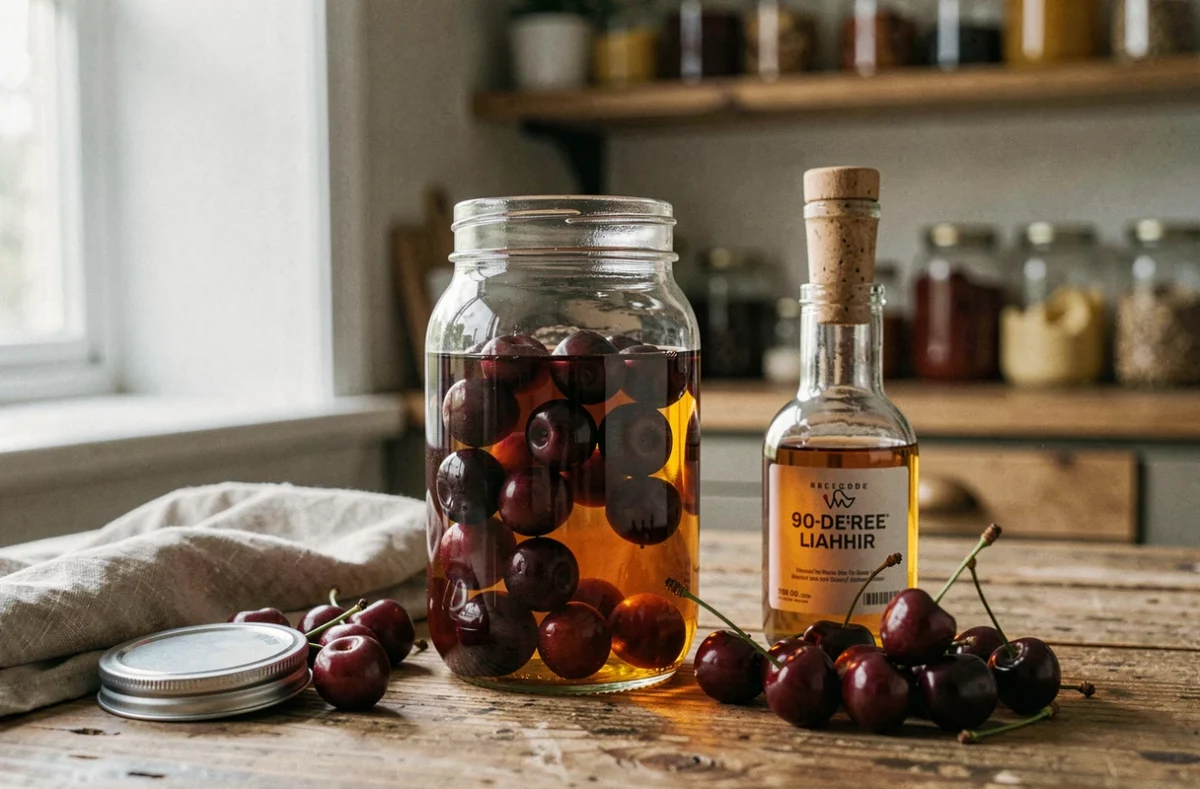
Every end of summer, the search for a high-proof alcohol to prepare jars of fruits rises in online queries. Among the most searched terms is the combination “90 alcohol for fruits Leclerc.” The phenomenon reflects a specific need: to find a suitable product for food maceration in a supermarket, without ending up with a bottle of household cleaner.
The shelf offer deserves careful examination because the degree displayed on the label is not enough to guarantee the safety of a jar intended for consumption.
Alcohol content and denaturants: what the degree does not reveal on the label
A bottle labeled “90°” can be either a household alcohol or a food alcohol. The difference does not lie in the degree but in the presence or absence of denaturants added to the product. Household alcohol contains substances like bitrex or methyl ethyl ketone, which make it unsuitable for ingestion. These additives allow the manufacturer to circumvent the taxes applied to spirits.
Food alcohol for fruits, on the other hand, is undenatured ethanol. It is subject to excise duties on alcoholic beverages, which explains a significantly higher price per liter. Confusion persists on the shelves because both categories share the same alcohol content and sometimes occupy neighboring shelves. The reflex to search in the cleaning aisle exposes one to a product error.
European regulation No. 1169/2011 governs the labeling of pre-packaged foodstuffs and requires the indication of the volumetric alcohol content for beverages exceeding 1.2% vol. This obligation helps to identify a product intended for food: a food alcohol carries an explicit usage mention (preparation of liqueurs, maceration of fruits). A household product does not have this mention, even if its degree is identical.
Those interested in 90 alcohol for fruits Leclerc would benefit from systematically checking the usage mention on the label before placing the bottle in their cart.
Availability in Leclerc stores: a far from uniform listing
The Leclerc brand operates on a cooperative model. Each store is managed by an independent member who decides on its assortment. This operation has a direct consequence: the presence of 90° food alcohol varies from one store to another.
The catalogs and pages of local stores available online do not show a nationally identifiable product sheet for this type of item. A consumer may find the product in one Leclerc and not in another located just a few dozen kilometers away. The drive service does not guarantee availability either: some highly taxed products are not listed on the pickup platforms.
This uncertainty partly fuels online searches. Before traveling, many individuals seek to confirm that their store indeed offers a 90° alcohol intended for maceration, not just a simple household alcohol. Field feedback varies on this point, and no centralized source allows for checking availability before going to the store.
Supermarket sales regime: license and tax framework
To sell an alcohol exceeding 18° for takeout, a stationary establishment like a supermarket must hold a large takeout license. This regime distinguishes supermarkets from street vendors, who are limited to beverages not exceeding 18°.
This regulatory framework explains why high-proof food alcohol remains confined to certain distribution channels. A neighborhood grocery store or a local market cannot offer this type of product without the appropriate license. The supermarket thus becomes the most accessible point of sale for an individual, concentrating demand on brands like Leclerc, Carrefour, or Auchan.
The price reflects this fiscal reality. Excise duties on undenatured ethanol are calculated per hectoliter of pure alcohol. A bottle of 90° food alcohol costs significantly more than a commonly consumed spirit at 40°, even though the purchased volume is often smaller. This discrepancy surprises occasional buyers, who mentally compare the price per liter with that of a bottle of vodka or rum.
Maceration at 90°: why this degree for fruits
The choice of a 90° alcohol for maceration is not arbitrary. A high degree serves two simultaneous functions:
- The extraction of aromas, pigments, and organic compounds from the fruit is faster and more complete at high proof. Concentrated ethanol acts as a powerful solvent on cell walls.
- The preservation of the jar is enhanced. At 90°, the environment is too hostile for most microorganisms responsible for fermentation or mold.
- The final result can be adjusted: it is then diluted with a sugar syrup or water to reach the desired drinking degree, usually between 15° and 25°.
A maceration carried out directly at 40° or 55° produces a different result. The extraction is slower and the aromatic profile less concentrated. This is not a flaw in itself, but the preparation logic changes: it takes more time, and the final product does not store as well without refrigeration.
Fruit quality and preparation errors: often overlooked variables
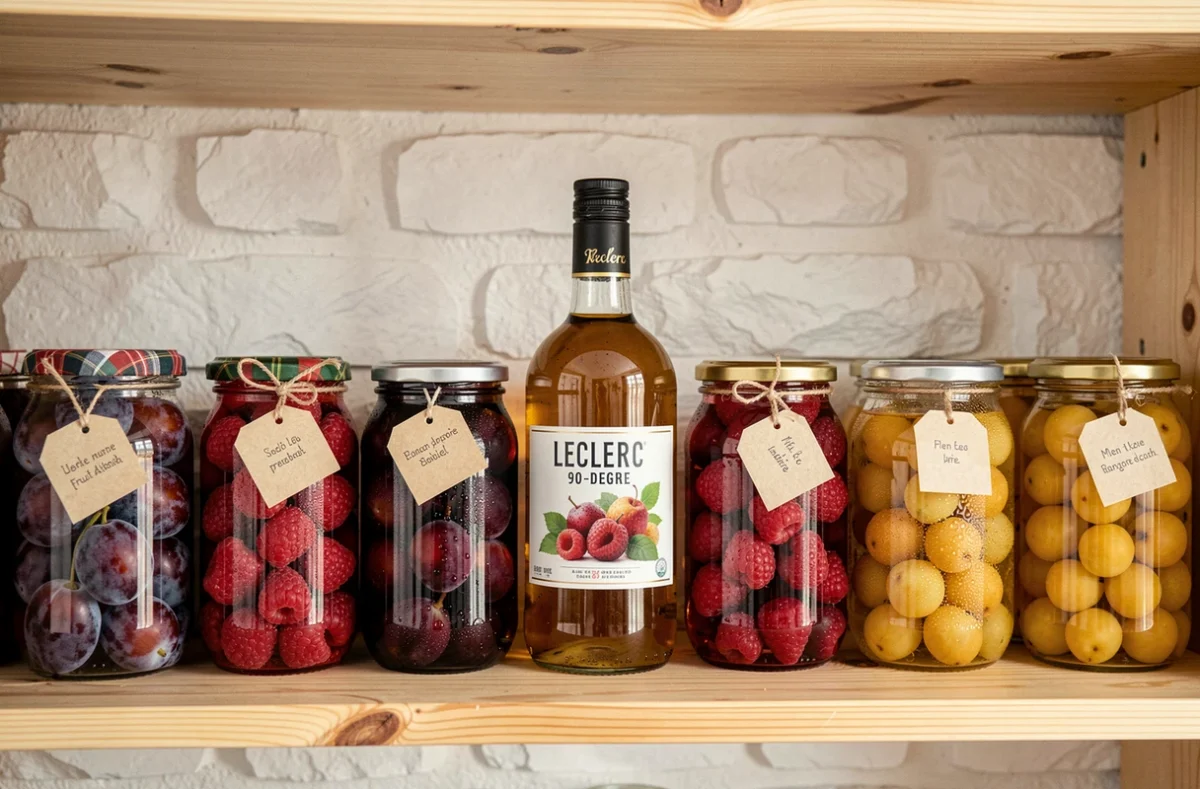
The choice of alcohol receives a lot of attention, sometimes at the expense of other equally crucial parameters. The ripeness of the fruit at the time of jarring plays a direct role in the result. A fruit that is too green gives an acidic and astringent maceration. A fruit that is too ripe, already affected by natural fermentation, can produce off-flavors.
Sugar acts as a co-preservative. Its dosage influences both the texture of the syrup and the shelf life. Too little sugar and the jar loses stability. Too much sugar and the fruit’s flavors are masked.
- The jar must be glass, with an airtight seal (rubber gasket or screw cap). Plastic should be excluded, as concentrated ethanol can attack certain polymers.
- The resting time before consumption varies depending on the fruits: a few weeks for cherries, several months for green walnuts.
- Storage should be done away from light and at a stable temperature. A jar exposed to heat or sunlight degrades faster, regardless of the alcohol degree used.
The appeal of 90° alcohol in supermarkets is based on a concrete need: to easily access a quality food product, at a clear price, in a trusted circuit. The challenge remains to ensure, at the time of purchase, that the chosen bottle indeed carries the mention of food use, and not just a high degree on the label.