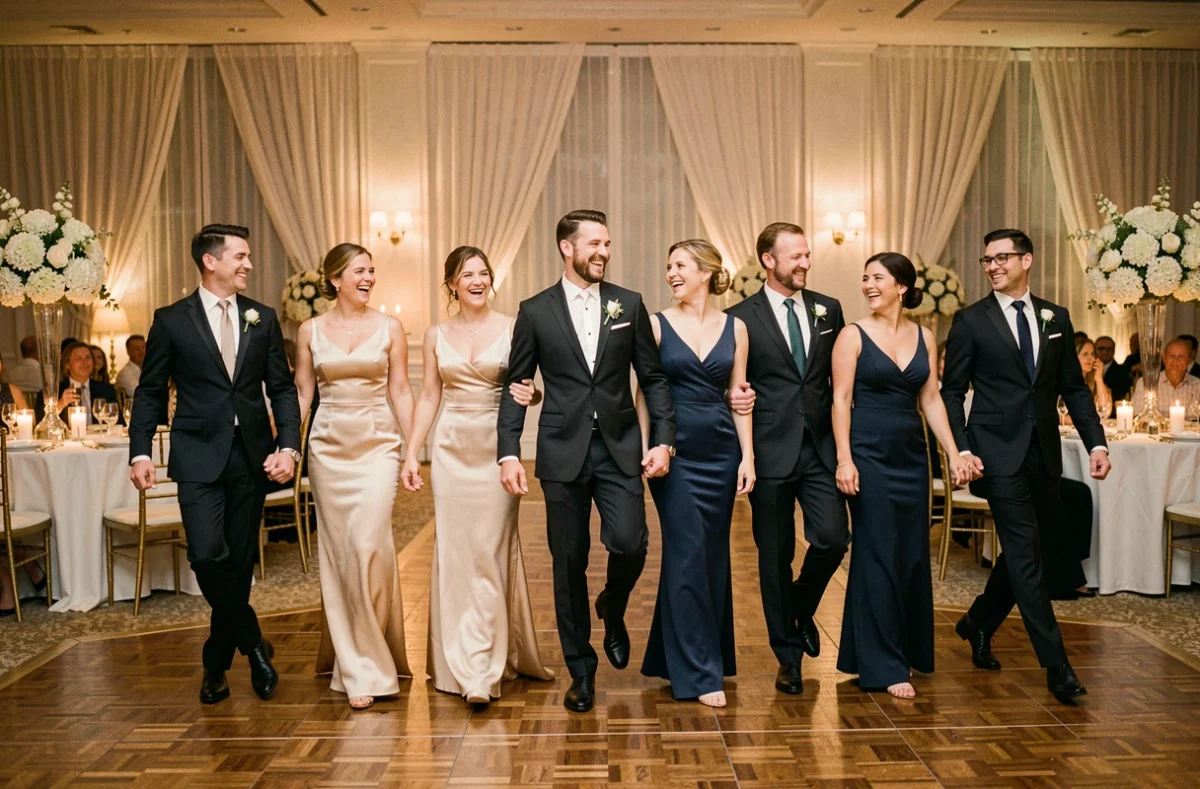
The Madison is a line dance that originated in the late 1950s, structured around side steps, backward movements, and quarter turns executed in a group to a steady swing tempo. At a wedding, this choreographic format brings together guests of all ages and skill levels, provided that the chosen piece respects a specific tempo range and a clear musical phrasing.
Tempo and musical structure of the Madison for weddings
The Madison is based on sequences of eight beats. Each step corresponds to a strong beat, meaning that the piece must provide a clear and consistent pulse. A song with a tempo that is too fast desynchronizes the group, while a song that is too slow breaks the collective momentum.
The ideal structure combines a marked rhythmic section (with a clearly audible drum or percussion), a simple melodic line, and regular breaks that allow dancers to keep track of the choreography. Pieces with sudden tempo changes or long instrumental bridges complicate coordination on the dance floor.
Before finalizing your playlist, the question of which song to choose for dancing the Madison deserves consideration based on the audience present and the moment planned during the evening.
Classic Madison tracks that work at weddings
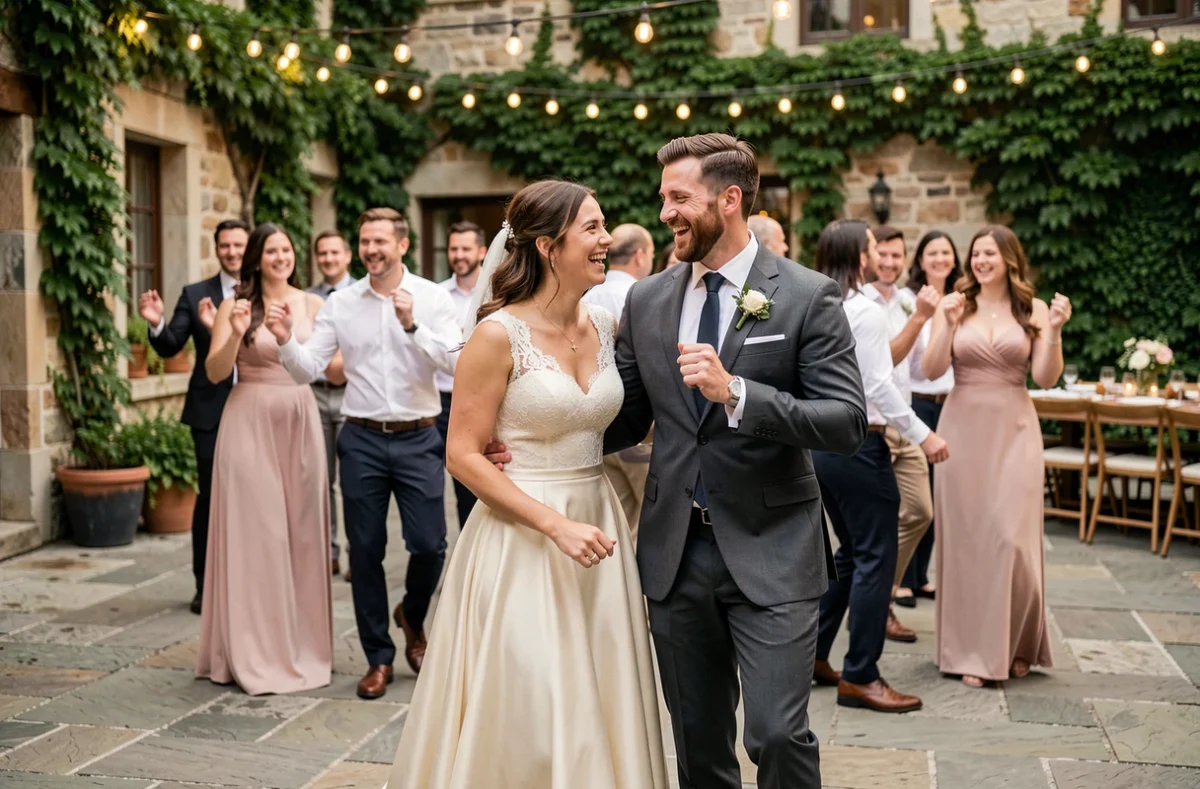
Some tracks have been associated with the Madison since its origins and remain reliable choices for a wedding. Their effectiveness lies in a stable tempo and a melody that is immediately recognizable across several generations.
Last Night by Will Burnett and His Madison Dance Trio
This piece is among the first compositions designed to accompany the Madison. Its duration (just over four minutes) corresponds to a complete set without tiring the dancers. The brass phrasing and swing rhythm make it accessible from the very first steps.
Le grand M. and other French titles
The French versions of the Madison offer a concrete advantage at a Francophone wedding: guests recognize the language, which facilitates spontaneous participation. Tracks like Le grand M., Sur un air de madison (Eric Bouvelle), or Reviens madison cover a musical spectrum ranging from musette to pop.
These pieces share a common characteristic: a moderate tempo that allows time to place each step. For an audience not used to dancing, this regularity makes all the difference between a successful collective moment and an empty dance floor.
Country and musette ambiance tracks
The Madison also lends itself to pieces from the country or musette repertoire, provided that the rhythm remains binary and steady. Artists like Marc Torchy or Jean Harduin offer instrumental versions that work well as background music during transitions, before or after the main dance moment.
- Last Night (Will Burnett and His Madison Dance Trio): classic swing, stable tempo, ideal for starting the Madison
- Sur un air de madison (Eric Bouvelle): French version with musette phrasing, accessible to all generations
- Sixties Madison (Fabien Georges): retro pop energy, a good compromise between classic and modern
- Honky Tonk Woman Madison: country style, marked rhythm, suitable for a sequence of several dances
Building a Madison playlist suitable for the wedding evening
Stacking Madison tracks is not enough to create a good dance moment. The order of the songs and their placement in the evening are as important as the choice of songs.
Placement in the evening’s schedule
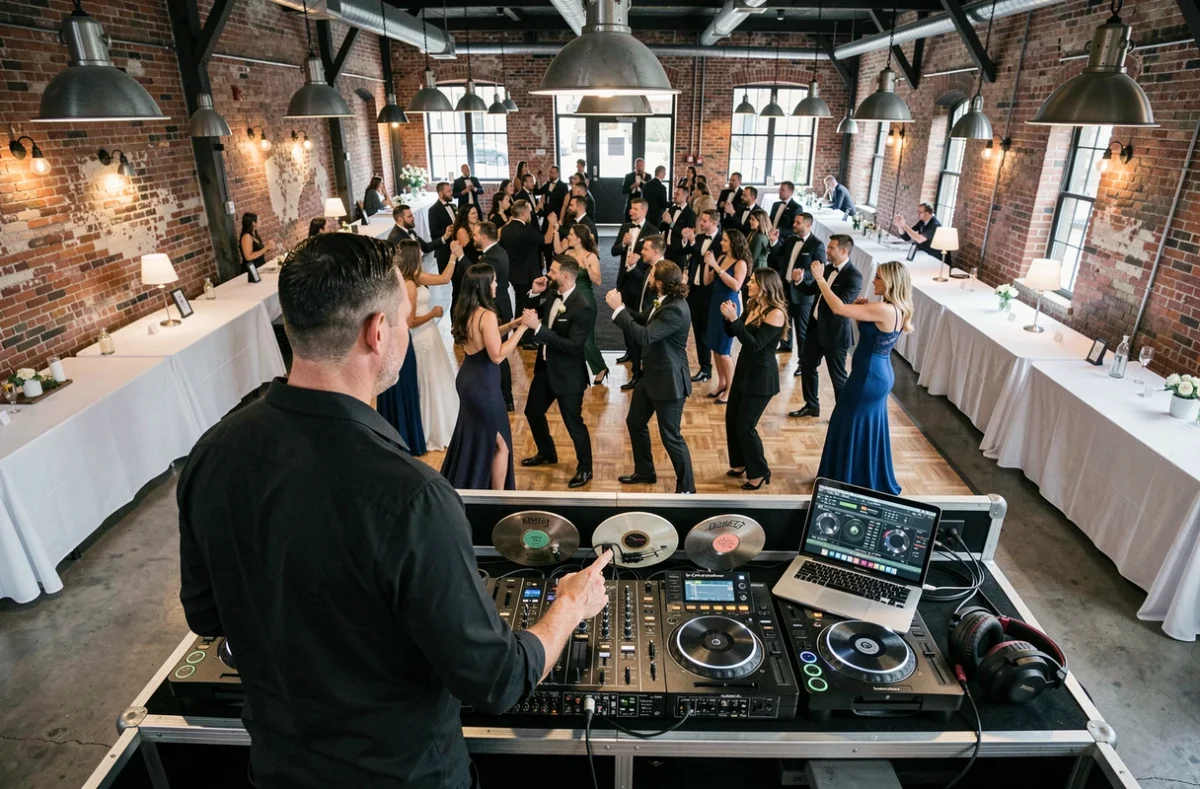
A professional DJ describes a method based on observing the dance floor and adjusting the songs to the energy of the audience. The Madison works as a unifying moment, but it does not produce the same effect at midnight as it does early in the evening.
If placed too early, it risks falling flat if guests are not yet relaxed. If placed too late, it can interrupt a free dance dynamic. The most effective slot is after the first dances, when the group is warmed up but not yet dispersed.
Sequence and duration of the Madison set
Two to three Madison tracks in succession are enough to maintain collective energy without exhausting the novelty effect. Beyond that, less motivated dancers leave the floor and the momentum drops.
The sequence benefits from alternating a very well-known track (to reassure beginners) and a less expected track (to regain attention). Starting with a recognizable French piece, then sliding into a swing or country title, allows for varying the atmosphere without breaking the rhythm.
Adapting the choice of Madison songs to the profile of the guests
A playlist designed for a predominantly young audience may stray from the expected classics. A testimonial published on a wedding planning forum describes an organizer who built their mix by favoring recent tracks and personal tastes, while keeping one or two classics for the older generations.
The Madison remains a group dance, not a musical showcase. The priority is on tempo and rhythmic clarity, not on the originality of the title. An unknown piece but perfectly timed will make for better dancing than a recent hit with an unsuitable tempo.
- Multigenerational audience: prioritize classic French songs (Eric Bouvelle, Le grand M.) and one English swing title
- Young audience: include one or two less expected tracks, provided the tempo remains compatible with the Madison steps
- Outdoor wedding: plan for slightly shorter tracks, as attention tends to wander more quickly without a defined dance floor
Planning the Madison as a block of two to three well-placed tracks during the evening yields better results than a scattered selection of ten tracks. The last parameter to check is the volume: Madison steps are matched to the ear, and sound that is too loud or too soft prevents dancers from following the collective rhythm.