
The French real estate market is going through a phase of recovery where national averages mask very contrasting realities. Stable prices here, marked declines there, rising credit rates after a lull: the signals for the start of 2026 do not point in the same direction depending on the territory or the type of property. Measuring these discrepancies allows for a better understanding of the situation than a simple national indicator.
DPE coefficient and resolutory clause: two regulatory changes to watch
Two regulatory changes will impact the conditions for buying and renting in the short term. The first concerns the energy performance diagnosis. The electricity conversion coefficient will change from 1.9 to 1.7 on January 1, 2027, according to Service-Public.fr.
Existing DPEs will retain their validity for ten years. If the new calculation method improves the rating, a free online update will be possible, without a new visit from the diagnostician.
In practical terms, homes heated by electricity that are currently close to an unfavorable threshold could change class. For a landlord whose property risks being banned from renting, this information conditions any decision regarding renovation or sale.
The second change: residential leases. To follow real estate news on Trend Immo, it should be noted that contracts concluded or renewed from October 1, 2026, will need to detail the resolutory clause more thoroughly, particularly in cases of unpaid rent, charges, or non-payment of the security deposit. The time frame before activation remains governed by legal procedure. However, the new standard contract requires a more detailed drafting of this clause, according to the ADIL of Pyrénées-Orientales.

Old real estate prices: the divide between rural areas and large cities
The SeLoger-Meilleurs Agents data from September 2026 paints a two-speed market. Rural areas are holding up better in terms of prices, while several large cities are showing a decline. Paris is presented as stable.
| Geographical area | Price trend (old, start of 2026) | Sales dynamics |
|---|---|---|
| Rural areas | Resilient growth | Strong demand |
| Paris intra-muros | Stability | Longer timelines |
| Large cities (excluding Paris) | Decline | Selective buyers |
These disparities are largely smoothed out by national overviews, which average out the differences into a single figure. A buyer relying solely on this aggregated indicator risks overestimating opportunities in certain metropolises or ignoring the dynamism of rural markets.
Old houses and apartments: diverging trajectories
According to available data, the depreciation observed on old houses appears more pronounced than that of apartments in several urban areas. The cost of energy renovation work, generally higher on a single-family home than on a condominium unit, is one of the factors put forward to explain this gap.
Mortgage rates: a rise that weighs on borrowing capacity
After several months of relative stability, average mortgage rates are showing an upward trend at the start of 2026. This movement mechanically drives up the cost of financing.
A few tenths of a point more on a long-term loan represents several thousand euros in total cost. First-time buyers, whose personal contribution is often limited, are the most exposed profiles to this variation.
- Checking borrowing capacity with updated rates, rather than those displayed six months ago, helps avoid a late application rejection.
- Comparing offers from several institutions remains relevant: the gap between the best and the worst proposal can exceed several tenths of a point.
- The rate is not the only parameter of the real cost of credit: borrower insurance, processing fees, and guarantees also weigh in the balance.
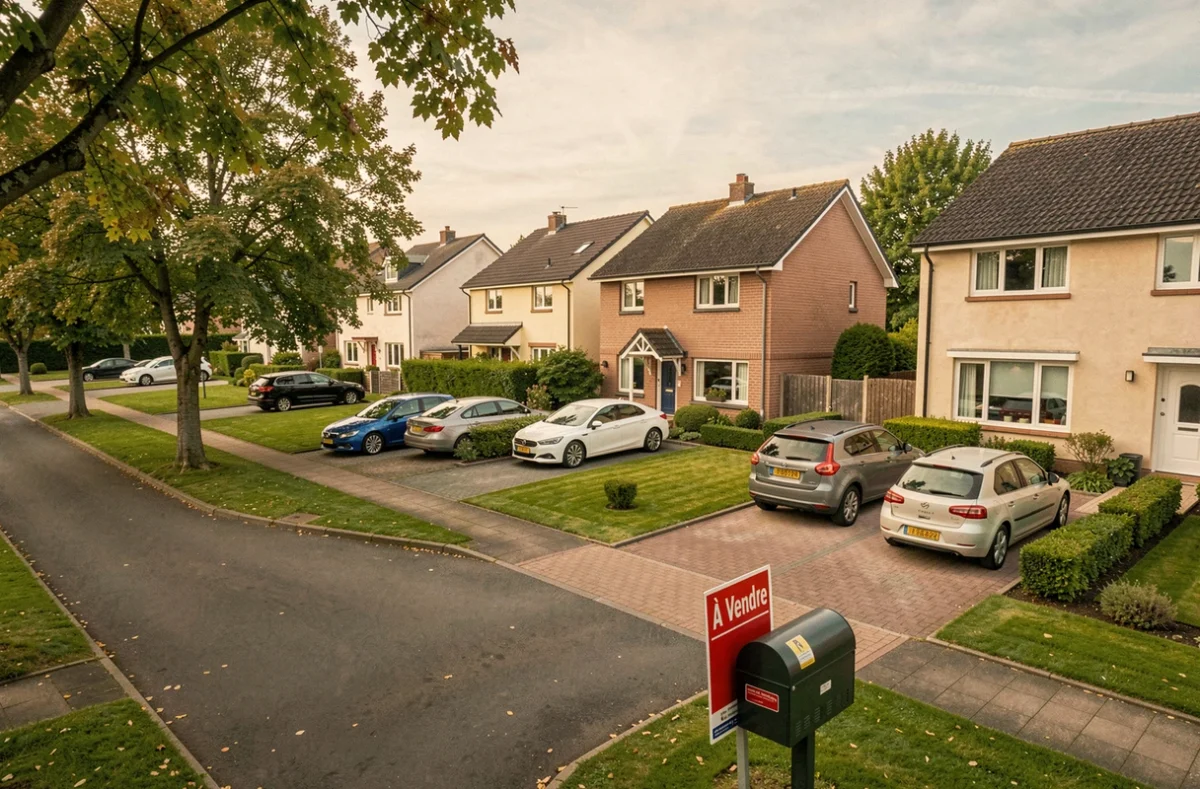
New and old real estate market: a widening gap
The new market is experiencing a sharp decline in sales while the old market remains stagnant. This gap between the two segments is explained by rising construction costs, the scarcity of available land, and developers’ wait-and-see approach in the face of regulatory uncertainty.
A housing bill proposes several measures to revive construction. The exact provisions are still under parliamentary discussion, but the stated intention focuses on simplifying authorization procedures and supporting home ownership.
Summer comfort and renovation: a new buying criterion
The Minister of Housing has indicated support for amendments to the housing bill concerning the installation of shutters and reversible heat pumps in condominiums, according to BFM Immo. Summer comfort is becoming a criterion for energy renovation alongside winter insulation.
An apartment under the eaves, lacking exterior shutters or a cooling system, could see its relative value decline if future regulations incorporate summer thermal comfort into the DPE or into condominium obligations. For a buyer, this parameter alters the evaluation framework of a property from the very first visit.
The market at the start of 2026 is therefore read less as a homogeneous block and more as a mosaic of local situations, where the type of property, the territory, and regulatory developments matter as much as the level of rates. The coming months will largely depend on the vote of the housing bill and the trajectory of the 10-year OAT, two variables that neither buyers nor sellers can control.