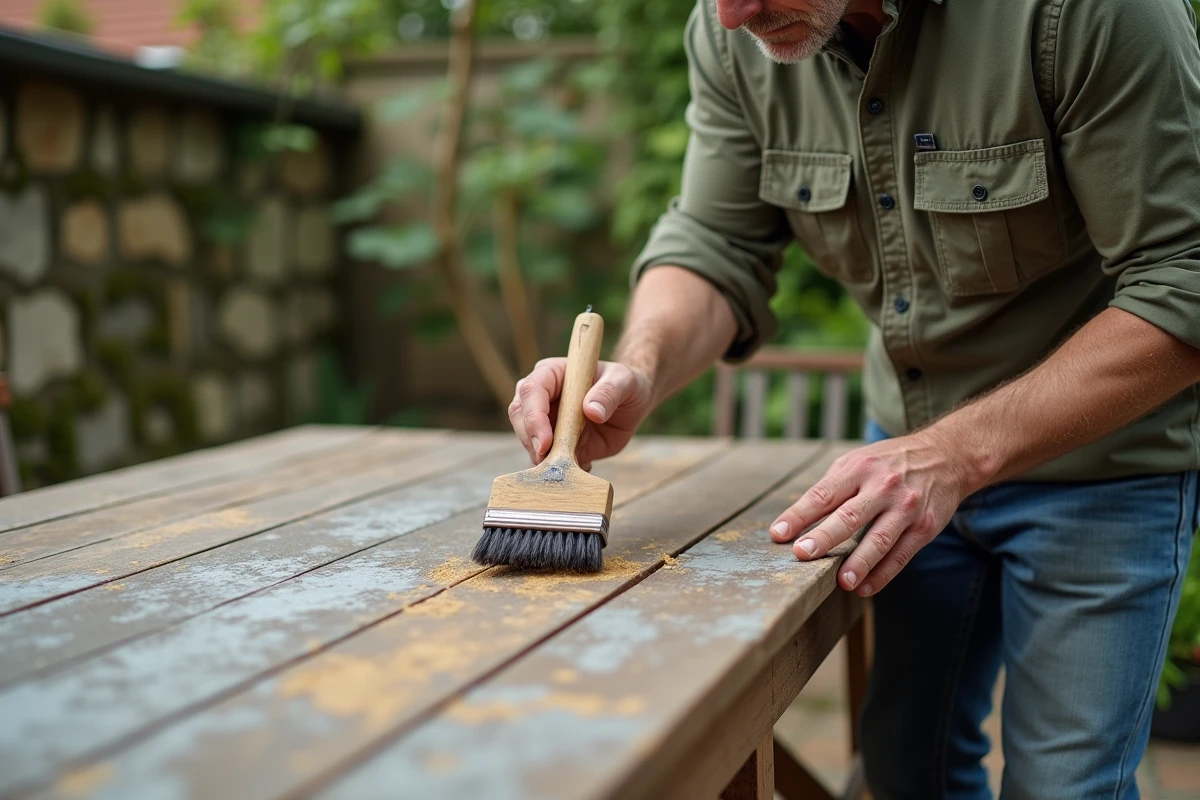
A teak garden set left outside for two winters without protection ends up covered with a uniform gray veil. The usual reflex, a high-pressure jet or aggressive sanding, damages the fibers and reduces the lifespan of the furniture. Wood gray remover acts on the chemical cause of this graying, the degradation of surface lignin, without attacking the structure of the material.
Graying of outdoor furniture: what really happens in the fibers
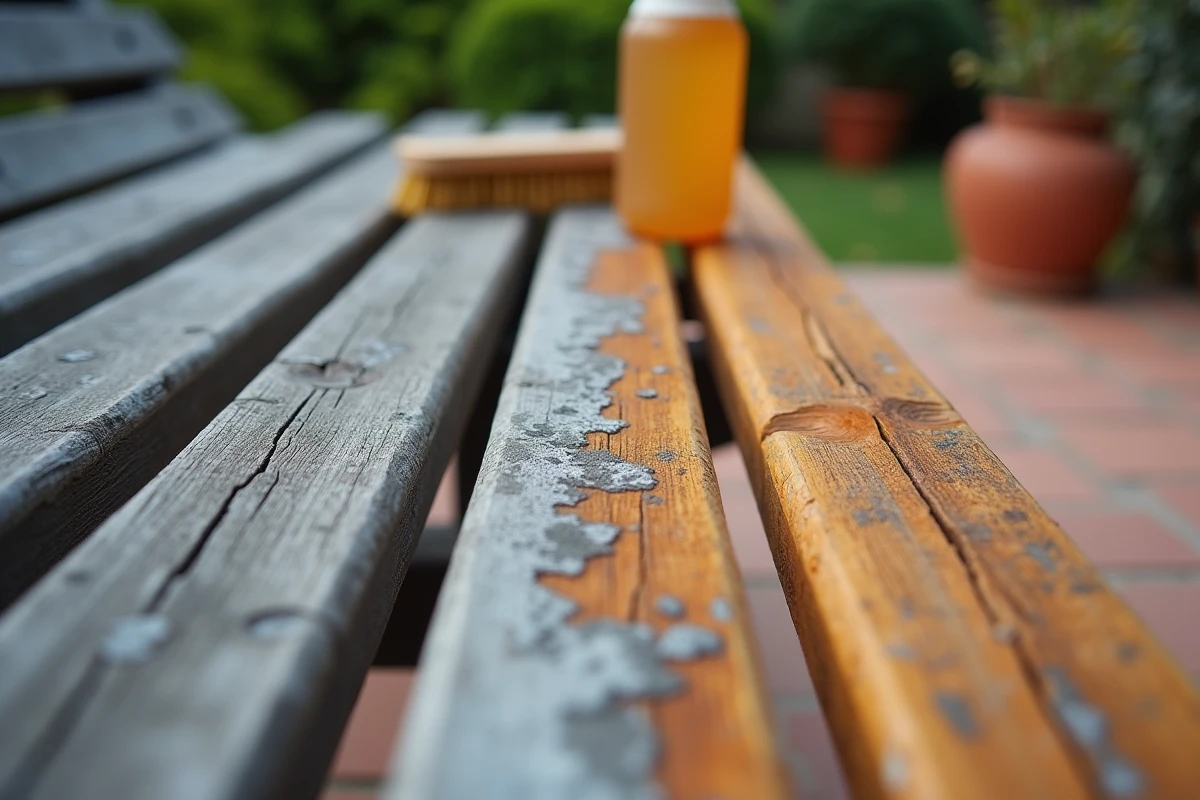
The gray that appears on a table or garden chair is not dirt. UV rays break down lignin, the natural binder of wood fibers. Moisture then carries away the residues of this decomposition, leaving a layer of bleached cellulose on the surface that traps dust and microorganisms.
On furniture, this phenomenon progresses faster than on a terrace. The thickness of the wood is less, the joints are finer, and horizontal surfaces (tabletops, armrests) accumulate more standing water. A pine or Douglas chair often grays in just a few months.
Before applying a product, it is more efficient to use an effective wood gray remover rather than sanding, because sanding removes material while the gray remover acts on the surface chemistry. On furniture with intricate profiles (spindles, curved slats), sanding is impractical in the corners anyway.
Wood gray remover for furniture: choosing the right product according to the wood type
Not all gray removers are suitable for all wood types. The choice depends on the wood’s reactivity to acidic agents and its tendency to release tannins.
Exotic woods: teak, ipe, cumaru
Teak and ipe are dense woods rich in natural oils. They tolerate oxalic acid-based gray removers well, which effectively dissolve the gray layer without penetrating too deeply. Abundant rinsing remains key: an acidic residue trapped in a mortise and tenon joint causes difficult-to-remove whitish stains.
Softwoods and European woods: pine, Douglas, spruce
These species are more porous and more prone to tannin rise after treatment. Recent formulations known as “low pH” or buffered limit this problem. They also reduce fibrillation, those small wood hairs that stand up after drying and require slight sanding.
On treated autoclave pine furniture, a preliminary test on a hidden area is essential. Treatment salts can react with certain acids and create greenish halos.
Application on furniture: field method in three passes
The method below works on most garden furniture, from solid benches to folding chairs. Work on one piece of furniture at a time, never flat on the lawn (the product burns the grass).
- First pass, cleaning: brush the surface dry to remove moss, lichens, and embedded dust. A simple stiff-bristle broom is sufficient. For heavily soiled furniture, a wash with clear water and a nylon brush prepares the surface better than a pressure washer set too high.
- Second pass, gray removal: apply the gray remover with a wide brush or low-pressure sprayer in an even layer. Let it act for the time indicated by the manufacturer, usually about fifteen minutes. Do not let the product dry on the wood, especially in hot weather.
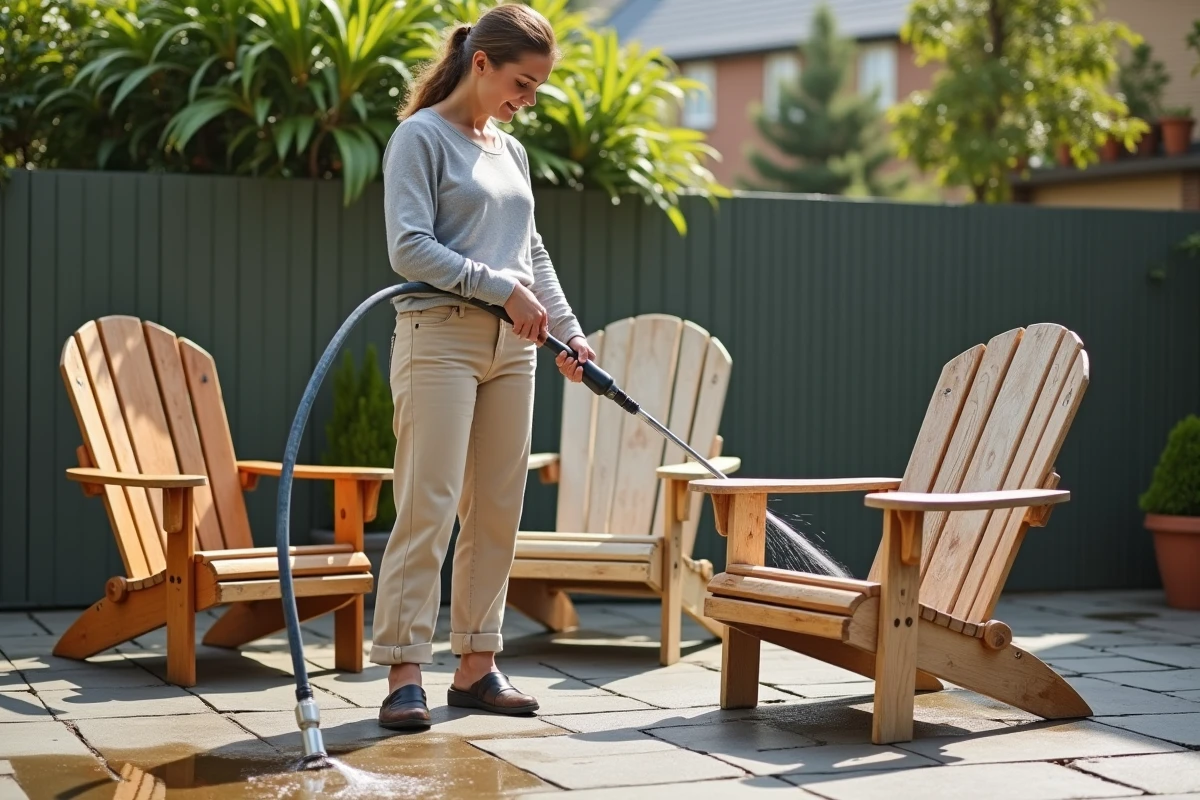
- Third pass, rinsing and neutralization: rinse thoroughly with clear water, from top to bottom to avoid streaks. On exotic species, some manufacturers recommend a pass with an alkaline neutralizer to stop the acidic action.
Then let the furniture dry for at least 48 hours before any finishing. The wood should be dry to the touch, including in the grooves and under the slats.
Protection after gray removal: saturator, oil, or stain for outdoor furniture
Gray removing without subsequent protection means repeating the operation the following year. The gray remover opens the wood pores and makes it receptive to a finishing product, making it the ideal time to nourish the surface.
The saturator is the most suitable choice for garden furniture. It penetrates the fibers without forming a surface film, which avoids peeling in friction areas (seats, armrests). A teak oil plays a similar role on exotic woods, reviving the original warm hue.
The stain, on the other hand, forms a film. On frequently handled furniture, this film wears off in places and creates unsightly marks. It is better suited for fixed elements like planters or screens.
Maintenance frequency according to exposure
A piece of furniture sheltered under a pergola and covered in winter can suffice with gray removal every two or three years. A set exposed full south without protection requires annual treatment, sometimes two applications of saturator per season. Returns vary on this point depending on the local climate and the species used.
Regulation and composition: what changes in formulations
The European regulation on biocidal products (EU No. 528/2012) and its recent updates have led manufacturers to reformulate several ranges. Gray removers are now positioned as detergents rather than deep treatment products, which simplifies their market introduction but also changes their mode of action.
ANSES highlighted in a 2023 note on wood treatment products that manufacturers are moving towards more targeted formulations. Specifically, this means that recent gray removers clean and revive the surface without claiming to provide lasting fungicidal protection. Protection remains the role of the saturator or oil applied afterward.
For garden furniture, this evolution is rather favorable: older aggressive formulations could weaken glued joints. Current products, less corrosive, better respect glues and stainless steel or brass hardware.
The graying of outdoor wood is not a foregone conclusion. An appropriate gray remover for the wood type, a methodical application, and a saturator applied immediately are enough to give several more years of service to a piece of furniture that many would have replaced.