“Yet capable of storing carbon, purifying water, and protecting biodiversity,” the forest is affected by climate change.
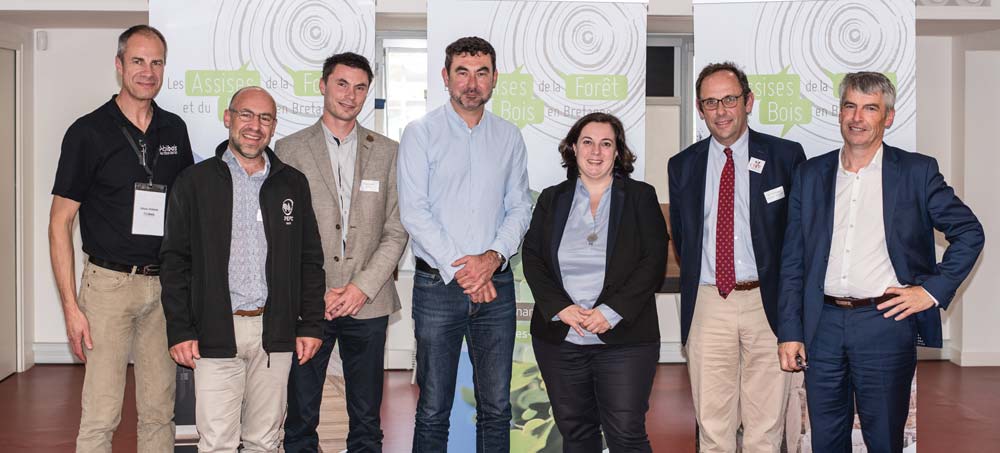
On Friday, October 18, in Saint-Brieuc (22), Abibois organized the third edition of the Forest and Wood Forum in Brittany, focused on climate change. “The French forest is dying and we are looking elsewhere,” begins Laurent Le Mercier from the company Sylva Expertise, pointing to the media spotlight on the Amazon while the fate of trees (30% of the national territory) has been ignored. “In the east of autumn, there is massive dieback of the Norway spruce. The French forest is falling by thousands of hectares. The industry is trying to save face by harvesting early… and then? We feel powerless,” says the forestry expert, looking towards Germany, which has launched a “Marshall Plan for the forest of 800 million euros.”
In Eastern Brittany, the Late Oaks
“Also, a tree takes a long time to die; we are already seeing the consequences of global warming on our forests. In eastern Brittany, oaks are falling due to the impact of summer drought,” explains the observer. “This already raises the question of which species to plant to ensure the long-term resilience of the forest.” For example, Laurent Le Mercier argues that species requiring water, such as Douglas fir or spruce, which are very present in central Brittany, will be advised with caution in other drier areas of the region.
Diversification of Species
President of the National Center for Forest Property (CNPF), Antoine d’Amecourt also asks: “In our sector, where one generation plants what the next generation will harvest, how do we address these rapid climate changes in our current choices? “Between southern Portugal and northern Scotland, 25 arboreta of 2 hectares have been planted with different species from different origins. Various management approaches and stands are being tested.” The idea is to monitor the development of trees while conducting precise meteorological surveys. For the specialist, in many places, “we do not cut in mixtures of species.” Joakim Rahuel from the Rahuel Bois sawmill in Combourg (35) agrees: “Monoculture refers to the risks in terms of limiting diseases and biodiversity. We will need to seek diversified species plantings to meet climate and environmental challenges.”
A Regional Forest Planting Fund In early 2019, the Region signed, with the State and professionals, the contract for the forestry and wood sector of Brittany 2019-2021, one of the most emblematic actions being the Breizh Forest-Wood system. Launched in 2015, this program has supported the planting of nearly 1,000 hectares of productive forests (1 million trees) across 160 public and private projects. Its ambition: renewing the forest means developing a forest resource on unproductive land (agricultural land…). Currently, Breizh Forest-Wood #2 aims to expand 500 hectares of forest by 2021. In Saint-Brieuc, Loïg Chesnais-Girard announced the creation, in 2020, of a Regional Forest Facility Fund to encourage green trade projects around trees in Brittany. The President of the Regional Council has established a course (Breizh Forest #2, Breizh Bocage, and trees in the city): “Developing our forests for concrete action on climate, biodiversity, and economic development. This carbon compensation fund will allow private and public companies to plant 5 million trees by 2025.” Read more on magazette.fr