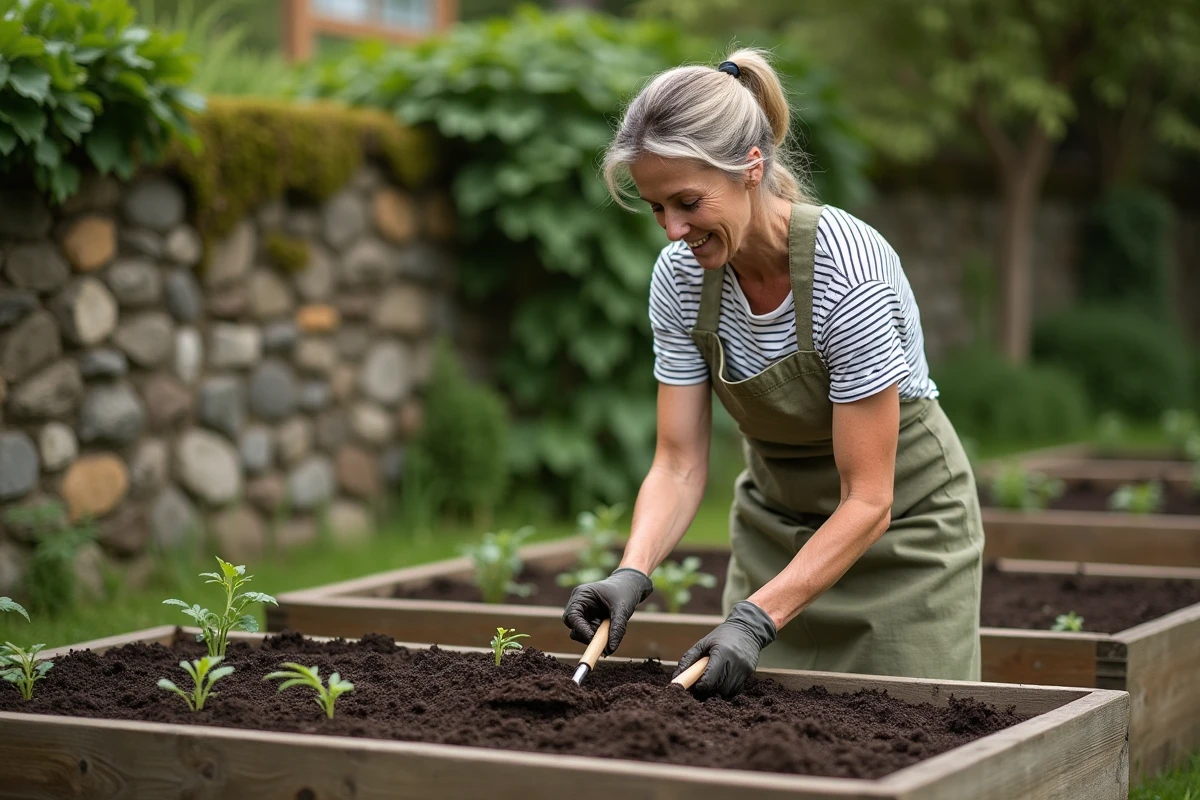
The grelinette remains the reference tool for loosening a bio vegetable garden soil without turning it over. However, assuming that every gardener can use it ignores a significant part of the public: weakened backs, worn joints, reduced mobility. Adapting soil work to actual physical capabilities changes the game regarding tool choice and cultivation methods.
Grelinette and Physical Limitations: Adapt the Tool or Change the Method
The classic five-pronged grelinette weighs between three and five kilograms depending on the model. Its use strains the lower back, shoulders, and wrists during the lever movement backward. For someone suffering from chronic lower back pain or hand arthritis, this repeated gesture over several linear meters causes rapid joint fatigue.
We recommend evaluating three parameters before choosing this tool: the ability to maintain a bent standing posture for more than ten minutes, the grip strength needed to pull two handles simultaneously, and the lower back tolerance for repeated lever effort.
A three-pronged grelinette reduces the working width and effort, but does not eliminate postural constraints. For gardeners whose backs can no longer tolerate the rocking motion, other approaches deserve serious comparison beyond the simple advice to “take your time.”
- The campagnole or biobêche lightens the gesture by offering shorter handles and a different grip, but remains a manual loosening tool.
- The digging fork, used by thrusting vertically without rocking, limits lower back load while aerating the soil to a proper depth.
- The American broadfork, wider, allows the use of body weight rather than arm strength, which is better suited for people with fragile shoulders but strong legs.
Specialized catalogs like grelinette-warrior.com detail the specifics of each model, making it easier to choose based on one’s morphology and physical constraints.
Bio Vegetable Garden Without Soil Work: The Layering Method
Starting a cultivation area without a grelinette at all is perfectly viable. Some bio gardening trainers advocate layering to create cultivable soil directly on a lawn or compacted ground.
The principle: lay down unprinted brown cardboard on the targeted area, cover it with a thick layer of mature compost, then add a plant mulch (hay, straw, dead leaves). The biological life of the soil (earthworms, fungi, bacteria) decomposes the cardboard in a few months and naturally loosens the soil beneath.
This technique is particularly suitable for people in wheelchairs or with very limited mobility, as it completely eliminates the loosening gesture. By combining this approach with raised beds, one can achieve an accessible bio vegetable garden without ever touching a soil working tool.
When the Grelinette Becomes Useful Again After Layering
In vegetable gardens established for several years with regular organic matter additions, the grelinette often becomes optional. The soil structure, stabilized by compost, mulching, and green manures, no longer requires systematic loosening each season.
We observe that the grelinette retains its usefulness in two specific cases: the recovery of compacted areas due to winter trampling, and the establishment of new planting beds on unprepared soil. Outside of these situations, a simple pass with a cultivator or claw is sufficient for direct sowing of small seeds.
Complementary Tools for Ergonomic Bio Gardening
The choice of surface tools is as crucial for the success of the vegetable garden as deep soil work. A gardener equipped with a good cultivator, an ergonomic trowel, and a lightweight rake can cover most daily tasks without straining.
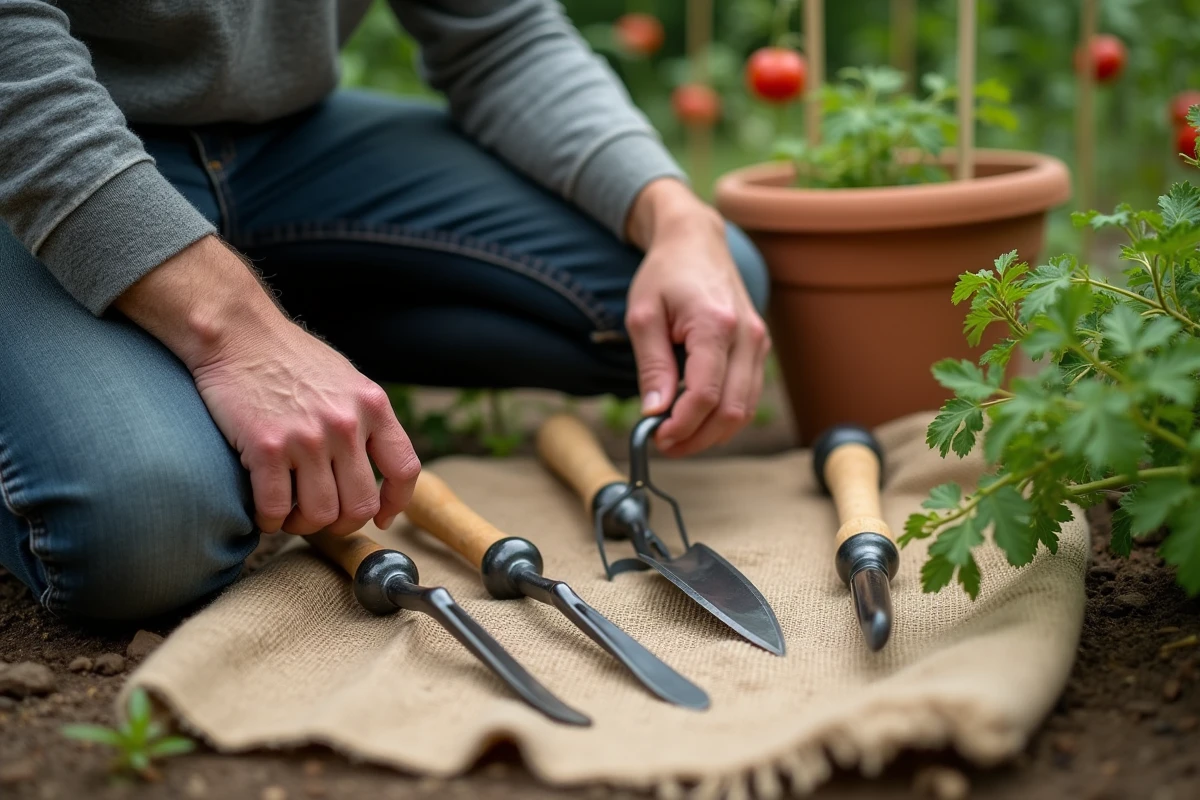
The four-pronged cultivator effectively replaces the spade for breaking up clods on the surface after a grelinette pass or on already soft soil. Its horizontal pulling motion puts less strain on the back than a vertical digging gesture.
Selection Criteria for Handles and Grips
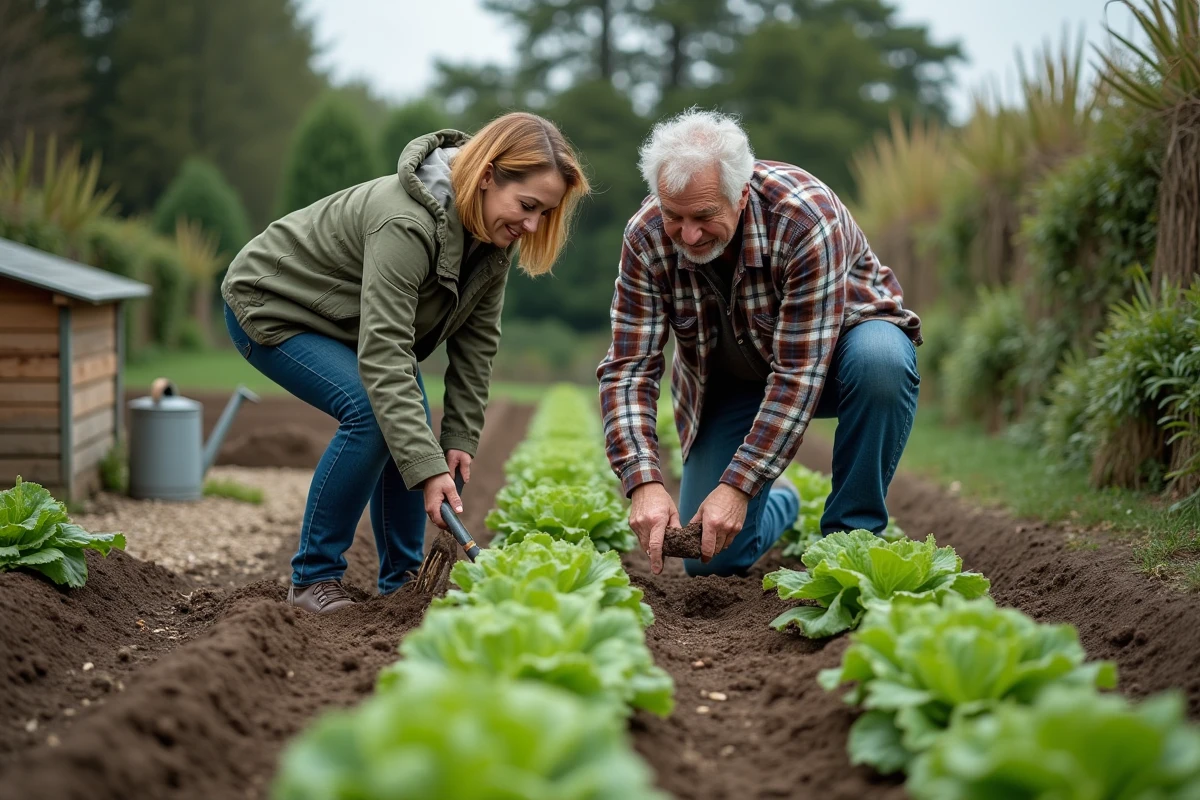
The length of the handles directly affects the working posture. Handles that are too short force one to bend more. For comfortable standing work, the handle length should correspond to the distance from the ground to the gardener’s elbow.
- Handles made of ash or beech wood absorb vibrations better than metal or composite, reducing wrist fatigue.
- T-handles are suitable for those with good grip strength, while D-handles distribute the effort across the entire palm.
- A non-slip coating on the handles prevents excessive gripping, which limits tension in the forearm.
Living Soil and Bio Vegetable Garden: Reducing Mechanical Work Through Biology
A biologically active soil decreases the need for mechanical intervention. Soil organisms (earthworms, springtails, mycorrhizal fungi) naturally create galleries and aggregates that aerate the soil and facilitate root penetration.
Nourishing this biological life involves three levers: never leaving the soil bare (permanent mulching), adding compost on the surface without burying it, and practicing crop rotation to vary root exudates. A permanently covered soil gradually does without loosening.
Green manures (phacelia, mustard, rye) play a direct mechanical role. Their roots break up compacted layers deep down, where neither the grelinette nor the fork can reach. Sown at the end of the season, they protect the surface against compaction from rain and frost.
The goal of an “easy” bio vegetable garden is not to multiply tools but to build a soil that requires less and less. The grelinette supports this transition; it does not replace it. For gardeners who cannot use it, the combination of layering-mulching-green manures produces comparable results over two to three seasons, without significant physical effort on the back or joints.